


https://www.youtube.com/watch?v=kMRXEWbzu7E Summary: Comparing RC Boats: $9 vs $3,000 Models Explained
If you want a real RC boats comparison, this video gives you one of the clearest examples on YouTube: a bathtub-friendly $9 toy, several mid-range speed boats, and a twin-motor $3,000 missile that pushes toward mph. On the original video, Kevin Talbot compares price, speed, handling, durability, and the kind of water each boat can actually handle.
That makes the episode more useful than a simple unboxing. You get a look at motorboats in miniature, but the lessons carry over to wider boating, water sports, powerboating, marine safety, GPS use, boat maintenance, and even seamanship. In 2026, with better batteries and more affordable brushless systems, choosing the right RC boat still comes down to three things: where you’ll run it, how fast you want to go, and how much risk you’re willing to manage.
Below, you’ll find the key details from the video, plus added context on regulations, safety gear, eco-friendly boating practices, beginner advice, and maintenance steps that matter once the cameras stop rolling.

Key Takeaways
The biggest lesson from this RC boats comparison is simple: price changes more than speed. It changes build quality, battery voltage, hull stability, recovery options, and repair costs. The $9 boat is a novelty you can use in a bathtub, while the $3,000 model uses twin motors, carbon-Kevlar construction, GPS speed tracking, and setup tuning that starts to resemble serious racing hardware.
According to Kevin Talbot, the jump from toy-grade to hobby-grade happens quickly once you hit the $50 to $100 range. At 0:15, the tiny $9 boat is shown as a fun starter. At 1:45, the Moray FTX enters as a basic but upgradeable hobby option. At 4:10, the high-end boat shows what happens when you combine 44 volts, twin motors, and a hull built for extreme power.
- Budget boats are best for beginners, kids, and tiny spaces, but they’re limited in range, speed, and durability.
- Mid-range boats give you the best value for regular use, especially if you want better steering, stronger batteries, and easier parts support.
- High-end boats demand setup knowledge, recovery plans, safety discipline, and a bigger water area.
- Safety matters: life jackets, retrieval tools, battery checks, and first aid kits aren’t optional if you’re boating near larger ponds, lakes, marinas, or docks.
- Eco-friendly habits like battery handling, debris cleanup, and avoiding wildlife disturbance make RC boating more responsible.
As demonstrated in the video, the fastest boat is not automatically the most enjoyable one. One Traxxas model is praised because it steers so well you can turn nearly on the spot at speed. That handling advantage matters just as much as top-end numbers.
Introduction to RC Boats
RC boats cover a huge range. At the low end, you have toy watercraft that cost less than lunch. In the middle, you get hobby-grade motorboats with LiPo batteries, brushless motors, and hulls that can handle proper pond or lake use. At the high end, you’re looking at specialist machines with racing hardware, tuned propellers, GPS logging, and performance levels that mirror full-size powerboating concepts.
This is why a careful RC boats comparison matters. If you buy too cheaply, you may outgrow the boat in one afternoon. Buy too expensively, and you might end up with a machine that’s hard to launch, hard to tune, and expensive to repair. The creator explains that some boats are forgiving and fun, while others can backflip, roll over, or even fail dramatically when pushed beyond their setup limits.
The same decision logic applies across boating categories. Sailboats prioritize efficiency and seamanship. Yachts focus on comfort and range. Kayaking emphasizes paddler skill and stability. Fishing boats need storage, fishing gear management, and practical layouts. RC boating is smaller, but the principles are familiar: match the craft to the mission.
If you’re new, start by asking:
- Will you run in a bathtub, small pond, lake, or coastal-style chop?
- Do you want easy fun, stunts, or maximum speed?
- Can you safely recover the boat if it flips or loses power?
- Do you have a charger, spare batteries, basic boat repair tools, and a place to maintain it?
Those questions will narrow your choice faster than staring at marketing claims.
The $9 RC Boat: A Fun Starter Option
At 0:15, Kevin Talbot shows the smallest and cheapest model in the lineup: a $9 RC boat that comes with a charger and controller, though you still need three AAA batteries for the transmitter. That detail matters. Super-cheap RC products often look inexpensive until you factor in disposable batteries, shorter runtime, and limited replacement parts.
Still, this little boat has a clear role. It’s a starter option, not a serious performance machine. The video shows it running in a tiny water space and then humorously proving it’s more submarine than race boat when overmatched. For kids, first-timers, or anyone who wants a harmless indoor-style toy for a bathtub or small pool, that’s perfectly fine.
The pros are obvious:
- Very low cost with almost no barrier to entry
- Simple operation for beginners
- Low speed, which reduces damage risk
- Compact storage and quick setup
The drawbacks show up just as quickly:
- Limited range and weak performance
- Poor rough-water ability
- Minimal durability compared with hobby-grade hulls
- Few upgrade or boat repair options
In our experience, these entry-level boats are best treated like a gateway into the hobby rather than a long-term purchase. If you enjoy the basic steering and want to move into outdoor boating, the next step should be a small hobby-grade boat with a better radio system and rechargeable pack. That jump gives you more realistic handling and a much better sense of whether RC boating is for you.
Mid-Range Options: The $50 to $700 Range
This is where the value lives. At 1:45, the video introduces the Moray FTX, priced around $50 (described in pounds in the clip and converted to dollars). It uses a LiPo battery, a brushed motor, and a rear propeller. On paper, that doesn’t sound wild, but it’s a major step up from a toy boat because it gives you repairability, better runtime, and a clearer upgrade path.
The creator also shows a tuned version with a 3S brushless setup, bringing the total value to roughly $60. That’s a useful reminder that mid-range RC boating often rewards smart upgrades more than huge spending. A better motor, battery, or prop can transform a basic hull if the platform is sound.
Then at 2:40, the $90 Super Dino appears with one of the video’s most interesting technical details: a jet boat system. Instead of an exposed propeller, it pulls water in from below and pushes it out the back through a steerable nozzle. According to Kevin Talbot, that means less risk of prop damage when bouncing over rocks or shallow obstacles. It also makes the boat more beginner-friendly in areas where debris is a problem.
The broader mid-range category stretches up to several hundred dollars, including Traxxas and Sonic Wake style boats that can hit roughly 50 mph. The video references:
- A $450 Traxxas model capable of about 50 mph, with self-righting and stunt ability
- A $420 Sonic Wake doing about 50 mph
- A Traxxas M41 around the higher end, using 6S LiPo power and roughly 22 volts
- A modified boat around $600 that failed dramatically when pushed on 6S
That last example is especially valuable. As demonstrated in the video, more voltage doesn’t guarantee safe speed. A setup that survives on 4S can fail on 6S, and once flames, sinking, or hatch loss enter the picture, your day changes fast. Mid-range boats are often the smartest buy because they offer enough speed to feel exciting without demanding the same tuning discipline as a true high-end race hull.
High-End RC Boats: The $3,000 Model
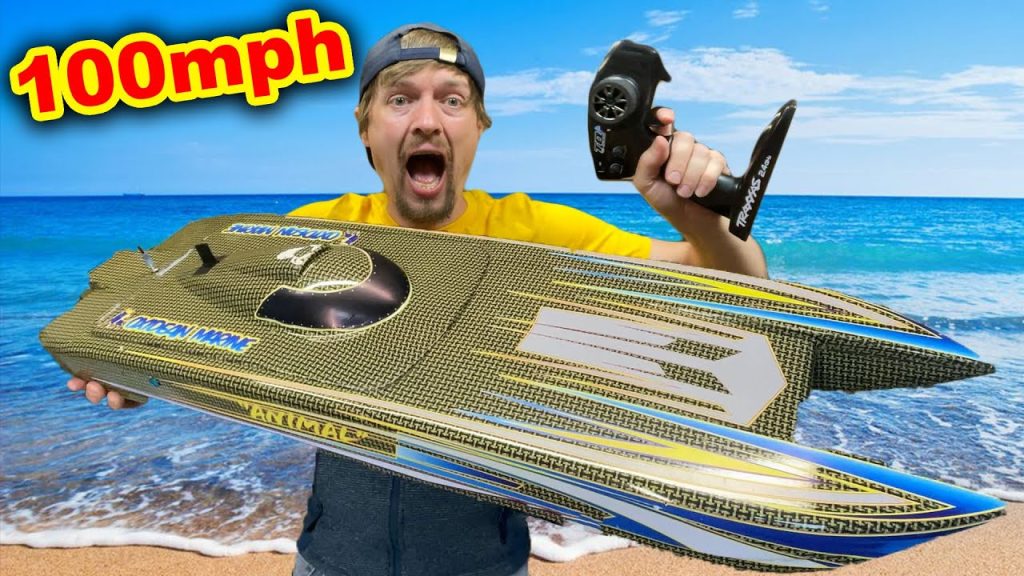
At 4:10 and throughout the later performance runs, the star of the video is the $3,000 high-end RC speed boat. This isn’t just a bigger version of a toy. It’s a specialist machine built around twin motors, 12S LiPo power, and about 44 volts. Kevin Talbot describes the motors as similar to Tesla-style electric hardware, and while that’s a playful comparison, the point is clear: this boat is in another class entirely.
The hull uses carbon and Kevlar, not basic molded plastic. That matters because once you’re pushing toward 100 mph, hull rigidity, hardware alignment, and weight placement become critical. The video’s GPS readings show just how serious the platform is: one pass records 83 mph, another around 77 mph, and a stronger run reaches 92 mph. That is outrageously fast for an RC watercraft.
So what are you paying for?
- More power from twin motors instead of one
- Higher voltage and larger battery capacity
- Advanced materials for strength and weight control
- Tuning potential through prop angle, prop selection, and battery position
- Data feedback through onboard GPS
But there’s a catch. As the video shows, high-end speed boats can backflip, roll over, hook violently in turns, or dive if setup changes go too far. That means the investment only makes sense if you have enough space, retrieval support, mechanical patience, and money for spares. If you enjoy setup work, performance tuning, and controlled testing, this tier can be thrilling. If you just want to rip around a pond, a mid-range boat may still be the better buy.
Safety and Maintenance Tips for RC Boats
At 7:20 and throughout the video, one theme keeps returning: boats end up stranded, upside down, smoking, or sinking. That makes marine safety and maintenance essential, even for small RC models. According to Kevin Talbot, recovery often involves another boat, a fishing line setup, or someone improvising from shore. That’s entertaining on camera, but in real life you should prepare before launch.
Start with the basics:
- Life jackets for anyone near deep water or getting into a rescue craft
- First aid kit in your vehicle or dock bag
- Gloves for handling damaged props, hatches, and hot electronics
- Recovery tools like a retrieval boat, tennis-ball line, or extendable pole
- Fire-safe battery bag for LiPo charging and transport
Boat maintenance is where you save money. After every run:
- Open the hatch and check for water ingress.
- Dry the hull, ESC area, and battery tray fully.
- Inspect the propeller, flex shaft, steering linkage, and rudder.
- Look for cracks near the strut, transom, and hatch seal.
- Recharge batteries only after they cool down.
The video also mentions salt water as a risk because it conducts electricity and speeds corrosion. If you boat in salt water near a marina, coastal launch point, or dock, rinse hardware with fresh water and dry it thoroughly. The same habit matters on full-size boats, sailboats, and fishing craft where corrosion destroys connectors, steering parts, and navigational tools over time.
If you’re boating at public lakes, also respect local regulations. Some areas limit speed, battery charging on site, or model craft near fishing zones, kayakers, and wildlife. Basic seamanship still applies, even at RC scale.

RC Boats Comparison: Performance, Speed and Handling
At 9:00 and in the runs around that point, the differences in speed and handling become obvious. The $9 boat barely belongs in the same conversation as the high-end hull. But the more interesting contrast is between the mid-range and top-end models, because that’s where buying decisions get real.
Speed depends on several factors:
- Motor type: brushed motors are cheaper and simpler, brushless motors deliver more power and efficiency
- Voltage: 3S, 4S, 6S, and 12S setups massively change output
- Hull design: deep-V and performance hull shapes affect stability and rough-water behavior
- Prop setup: pitch, diameter, and shaft angle can increase top speed or destabilize the boat
- Weight distribution: too far back and the bow lifts; too far forward and it can submarine
The creator explains that one Traxxas model isn’t the fastest, but it may be the best overall because it corners so well. That’s a critical buying lesson. A boat that does 50 mph confidently is often more fun than one that threatens to flip every time you steer. Meanwhile, the $3,000 model’s GPS-backed numbers of 83 mph and 92 mph prove its potential, but the tuning margin is tiny. A small steering input at speed can trigger a violent reaction.
This mirrors real boating too. Full-size motorboats, yachts, and even chartering decisions depend on weather conditions, coastal navigation, and hull suitability. You wouldn’t pick a flat-water race boat for ugly inlet chop. Likewise, you shouldn’t buy a near-100 mph RC machine if your local water is cramped, crowded, or full of floating debris.
If you want reliable performance, prioritize this order:
- Handling
- Recovery ease
- Parts support
- Top speed
That order may sound less glamorous, but it usually leads to more seat time and fewer broken boats.
Eco-Friendly Boating Practices
Most RC boat videos focus on speed. Fewer talk about environmental impact. That’s a missed opportunity, because eco-friendly boating practices are easy to adopt and make a real difference. Whether you run RC boats, kayaks, sailboats, fishing boats, or chartering vessels, good habits protect the same waterways.
First, manage batteries responsibly. LiPo packs should never be tossed in household trash. Store them at storage voltage, transport them in fire-safe bags, and recycle damaged packs through proper battery programs. Second, avoid wildlife disturbance. Don’t run high-speed boats near nesting birds, reeds, or areas where anglers are actively fishing. Fast passes close to shore can stress animals and ruin other people’s time on the water.
Third, pick clean launch areas. If a pond, marina edge, or dock zone already has trash, don’t add broken props, zip ties, tape, or packaging. In our experience, bringing one small cleanup bag turns a hobby session into better stewardship. According to our research, hobby communities that self-police noise, litter, and safety issues tend to keep access to public water much longer.
Here are practical steps you can use right away:
- Run during quieter periods to reduce conflicts with fishing, paddling, and family boating
- Use retrieval methods that don’t leave line or debris in the water
- Avoid fuel-powered contamination concerns by sticking with well-maintained electric setups
- Rinse boats away from natural shorelines if they’ve been in salt water
- Check local boating licenses or park regulations if the site requires permits for watercraft use
If you boat with pets nearby, add one more rule: keep dogs away from launch and retrieval zones where spinning props, hot batteries, and tangled lines create avoidable hazards.
Beginner’s Guide to Choosing the Right RC Boat for Your Needs
If the video leaves you asking, “Which one should I actually buy?” here’s the practical answer. Your best choice depends less on headline speed and more on where you launch, how you recover, and how much maintenance you’ll tolerate. That’s true in RC boating and full-size boating alike, whether you’re talking about fishing skiffs, sailboats, yachts, or weekend motorboats.
Use this framework:
- Small indoor or backyard water: get a toy-grade boat under $20.
- Calm pond or local park lake: look at $50 to $150 brushless-ready boats.
- Large open water with a chase option: consider $400+ performance boats.
- Extreme speed runs: only move to the $3,000 tier if you understand setup, GPS logging, battery care, and boat repair.
You should also think like a real boater. Do you have a launch spot near a dock or marina? Do local regulations allow fast RC use? Will you need navigational tools or a spotter if you’re running far out? Is the weather stable, or will wind and chop make the hull unpredictable?
For budgeting, don’t forget the hidden costs:
- Spare batteries and chargers
- Replacement props and shafts
- Silicone grease, tape, and hatch seals
- Recovery gear
- Travel to suitable water
And if you’re comparing hobbies, remember this: RC boating is dramatically cheaper than financing a real watercraft, paying marina fees, buying fishing gear, or maintaining a trailer boat. It can be a surprisingly good training ground for mechanical awareness, throttle discipline, and weather judgment.
Frequently Asked Questions
Drive in swells by approaching waves at a moderate angle, reducing speed before impact, and avoiding hard turns on the face of a wave. Keep the hull balanced, watch weather conditions closely, and use smooth throttle inputs so the boat stays settled instead of launching or stuffing the bow.
What is the best hull design for rough water?
A deep-V hull is usually the best choice for rough water because it slices through chop more effectively than flatter designs. As demonstrated in the video, hull design has a direct effect on handling, turning confidence, and whether a boat stays planted or becomes unstable at speed.
Can you boat through Haulover Inlet?
Yes, but only if conditions are favorable and you have the right experience, safety gear, and local knowledge. For full-size boating, check tides, wind, current, and marine advisories first; for RC boats, stay completely clear of navigational channels and areas used by larger watercraft.
What is the most popular sailing YouTube channel?
Popularity changes over time, but Sailing La Vagabonde is widely recognized as one of the most popular sailing YouTube channels. If your interest is fast electric watercraft rather than cruising sailboats, Kevin Talbot is a much better fit.
What price range is best for a beginner RC boat?
For most people, $50 to $150 is the sweet spot because it offers hobby-grade handling without the cost and risk of extreme-speed machines. The creator explains that ultra-cheap boats are fun novelty items, while mid-range options are far more usable on real water.
Conclusion and Next Steps
This RC boats comparison makes one thing clear: the best RC boat isn’t the most expensive one. The right choice is the one that fits your water, your skill level, and your willingness to maintain it. The $9 boat is a cheap laugh and a solid first taste of the hobby. The mid-range class offers the best blend of speed, control, and value. The $3,000 machine is thrilling, but it demands respect, setup knowledge, and a serious recovery plan.
According to Kevin Talbot, the fun factor often comes from handling and reliability, not just raw mph. That’s why your next step should be practical:
- Pick your launch location first.
- Set a total budget including batteries, charger, and spares.
- Buy safety gear before your second battery pack.
- Use GPS if you plan to test speed seriously.
- Clean, dry, and inspect the boat after every run.
If you want to watch the original runs, start with Kevin Talbot’s video here: $9 vs $3,000 RC Speed Boat!. You can also browse more from the channel at Kevin Talbot on YouTube. For practical boating safety guidance that also applies to waterfront habits around RC use, the U.S. Coast Guard boating safety page is a useful reference: https://www.uscgboating.org/.
If you’re choosing your first serious boat in 2026, the safest recommendation is still a quality mid-range model with good parts support. You’ll drive more, repair less, and actually enjoy the hobby instead of constantly rescuing a floating rocket.
Frequently Asked Questions
How to drive a boat in swells?
Drive in swells by meeting waves at a controlled angle instead of hitting them broadside, and reduce speed before the crest so the hull stays planted. Keep your weight and trim balanced, watch wind direction, and make small steering inputs rather than sudden turns; the same principle applies to RC boating when rough water starts bouncing the bow.
What is the best hull design for rough water?
For rough water, a deep-V hull is usually the best all-around design because it cuts through chop better than flatter hulls. As demonstrated in the video, hull shape directly affects stability, turning, and whether a fast boat skips, hooks, or submarines when conditions get messy.
Can you boat through Haulover Inlet?
Yes, you can boat through Haulover Inlet, but only with local knowledge, the right weather window, proper safety gear, and respect for tides and current. For full-size boating, always check local regulations, marine forecasts, and navigational tools before attempting a challenging inlet; RC boats should stay far away from real navigation channels.
What is the most popular sailing YouTube channel?
There isn’t one permanent winner because popularity changes by year and by metric, but channels like Sailing La Vagabonde are widely considered among the most popular sailing YouTube channels. If you want high-speed RC content instead, Kevin Talbot is a strong reference point for watercraft testing and entertaining RC reviews.
What price range is best for a beginner RC boat?
For most beginners, a mid-range model between about $50 and $150 is the sweet spot because you get better batteries, stronger steering, and more usable speed without the cost or risk of a mph machine. According to Kevin Talbot, entry-level boats are fun, but the mid-range options offer the most practical step up in real-world boating performance.
Key Takeaways
- The $9 RC boat is a low-risk, beginner-friendly toy, but it’s limited to tiny water spaces and very light use.
- Mid-range RC boats between roughly $50 and $700 offer the best mix of speed, durability, repairability, and real-world fun.
- The $3,000 twin-motor boat delivers extreme performance with GPS-verified runs up to mph in the video, but it requires tuning skill and careful recovery planning.
- Safety and maintenance are essential: use proper battery practices, retrieval gear, life jackets near deep water, and inspect the hull after every run.
- Eco-friendly boating habits like battery recycling, wildlife awareness, and debris cleanup make RC boating more sustainable and help preserve access to public water.