




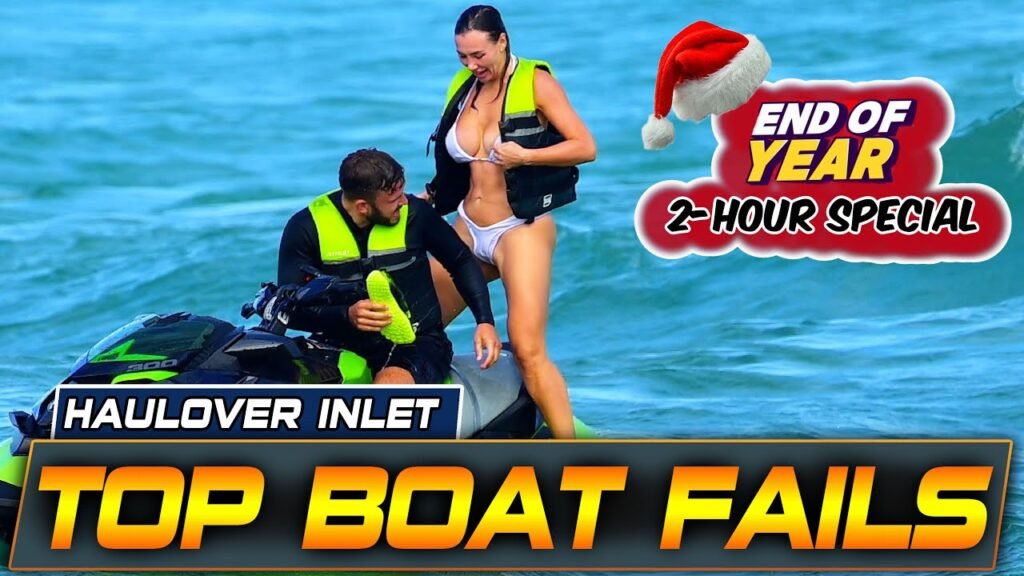
https://www.youtube.com/watch?v=V5MtdqM_C7w Summary: Haulover Inlet boat fails and safety lessons
Haulover Inlet boat fails are more than dramatic internet clips. They show how rough water, poor judgment, vessel limitations, mechanical problems, and navigation hazards can combine within seconds. Boat Zone’s compilation, BOATS DESTROYED!! WORST FAILS OF ALL TIME AT HAULOVER INLET, collects viral footage from roughly six years of online boating incidents at Haulover Inlet, Florida.
The creator presents spectacle, but you can use the video as a safety case study. The footage includes crashes, capsizing, sinking boats, wakeboarding accidents, personal-watercraft wipeouts, and close calls. Some clips may show deliberate wake jumps or stunts rather than genuine accidents, so you shouldn’t assume that every dramatic moment has the same cause or outcome.
Content warning: the compilation may include collisions, people falling into the water, distressing rescue footage, visible vessel damage, and possible injuries. The supplied transcript confirms only the compilation’s general premise; it doesn’t verify the date, vessel identity, injury count, fatality status, or final outcome of individual clips. Watch the original Boat Zone video with that limitation in mind.
TL;DR: The Biggest Lessons From Haulover Inlet Boat Fails
The practical lesson from these Haulover Inlet boat fails is simple: an inlet crossing requires preparation, restraint, and a willingness to turn around. You need speed control, suitable trim, a sober and attentive operator, a passenger briefing, and correctly fitted life jackets before entering rough water.
The highest-risk patterns include large waves meeting an outgoing tide, reckless driving, overloaded boats, sudden steering inputs, sharp turns, loss of control, and operators entering conditions beyond their experience. A posted speed limit doesn’t mean that speed is safe when visibility is poor, traffic is dense, or waves are breaking across the channel.
- Check the marine forecast, tide, current, and local advisories.
- Inspect the engine, steering, fuel system, bilge pumps, and propeller.
- Secure coolers, fishing gear, boards, and other loose equipment.
- Reduce speed, keep passengers seated, and maintain a clear view ahead.
- Turn around before deteriorating conditions remove your safe options.
A viral clip also needs careful labeling. A near miss is not a confirmed accident, and footage alone can’t establish injuries, fatalities, vessel damage, or legal fault. According to Boat Zone, the material is a compilation of viral moments—not a verified incident database.
Why Haulover Inlet Turns Small Mistakes Into Major Accidents
Haulover Inlet can produce difficult conditions because tidal current, opposing swell, shallow areas, channel edges, large waves, and concentrated recreational traffic interact in a confined space. When water moving out of the inlet meets incoming swell, wave faces can become steeper and less predictable. A boat that handled calm bay water comfortably may respond very differently at the inlet mouth.
Rough water and bad weather increase the chance of bow stuffing, broaching, rollovers, passenger falls, and capsizing. A boat approaching a wave too fast may launch over the crest; approaching broadside can expose the hull to a powerful roll. If the bow rises high enough to block the operator’s view, the driver may not see another boat, a swimmer, or the next breaking wave.
Vessel design matters. Speedboats and motorboats may have enough power to climb a wave but can lose control after a sudden throttle or steering change. Fishing boats may take water over the bow when carrying equipment and passengers. Pontoon boats have stable decks in many conditions but can be vulnerable to side waves. Sailboats may have limited maneuverability in crowded water, while jet skis and other personal watercraft can launch, eject riders, or land unpredictably.
Before departure, follow this sequence:
- Review NOAA National Weather Service marine forecasts, including wind, wave height, visibility, and storm warnings.
- Check local tide and current information rather than relying on yesterday’s conditions.
- Identify the marked channel and understand where shallow edges may affect wave shape.
- Watch other vessels from a safe distance before committing to the crossing.
- Postpone the trip if the exit looks unsafe or your crew lacks experience.
The Main Types of Haulover Inlet Boat Fails
Organizing the compilation by incident type makes its safety lessons easier to apply than watching clips in upload order. The main categories are boat crashes, collision, capsizing, sinking boats, wakeboarding accidents, and personal-watercraft wipeouts. Each category points to different decisions that you can change before your own trip.
Crashes, collisions, and capsizing
Speedboats and motorboats may crash after excessive speed, a sudden turn, or a loss of control on a wave. A collision can involve two moving boats, a stationary object, or a vessel that becomes disabled in the current. Fishing boats can swamp when a wave breaks over the bow, while pontoon boats may roll or take water when hit from the side. Sailboats need extra room to maneuver, particularly where powerboats and jet skis cross unpredictably.
Personal watercraft and wakeboarding accidents
Jet skis and other personal watercraft are agile but unforgiving. Riders can be ejected when they approach a wave or wake without enough distance, land at the wrong angle, or accelerate into a crowded area. Wakeboarding accidents may be deliberate jumps, failed landings, or genuine falls; the clip alone may not show whether a safety boat, spotter, or protective equipment was present.
Report each clip with three labels: visible facts, reasonable but unconfirmed inferences, and details that remain unverified. Say “the boat appears to roll after crossing a wave” rather than claiming a specific injury or death without a reliable source.
What Causes the Worst Boat Crashes and Capsizing?
The most serious Haulover Inlet boat fails usually involve several factors rather than one isolated mistake. Operator error includes reckless driving, excessive speed, sudden steering input, improper trim, and failure to maintain a lookout. The video demonstrates how quickly a boat can become unstable when the operator treats a wave like a ramp instead of a hazard.
An overloaded boat has less freeboard—the distance between the waterline and the gunwale—so a smaller wave can send water aboard. Uneven passenger placement can also make steering and balance worse. Once water accumulates, the boat becomes heavier and lower, creating a cycle that can end in swamping or capsizing.
Mechanical problems create a separate risk. Engine failure, throttle problems, steering failure, fuel issues, and propeller accidents can leave a vessel unable to face the waves or avoid traffic. A disabled boat may be pushed sideways by current, which is especially dangerous near a channel edge or the path of larger vessels.
Use this prevention checklist before leaving:
- Stay below the capacity plate’s passenger and weight limits.
- Distribute people and gear evenly; don’t stack heavy equipment at the bow or stern.
- Test the engine controls, steering, bilge pumps, and emergency kill switch.
- Inspect fuel lines, battery connections, cooling water, and the propeller.
- Keep hands and feet inside the vessel and away from rails during rough crossings.
- Shut down the engine before anyone enters the water; a spinning propeller can cause catastrophic injury.
Safety Rules That Could Prevent Most Viral Boat Fails
Navigation rules help you predict what other operators should do, but they don’t excuse pressing ahead into an obviously unsafe collision. In crossing situations, determine which vessel has priority and make an early, obvious maneuver. When meeting another boat, maintain a predictable course when safe; when overtaking, keep clear of the vessel you pass. If the other operator behaves unpredictably, slow down and create room rather than defending your theoretical right-of-way.
Safe speed depends on visibility, traffic, wave conditions, maneuverability, and stopping distance. Reduce speed in crowded channels, heavy traffic, poor visibility, bad weather, and rough water. A posted limit is a ceiling, not permission to travel at that speed in every condition.
Carry and use equipment appropriate to the vessel and trip:
- Wearable, properly fitted life jackets for every person.
- A throwable flotation device where required or recommended.
- A sound-producing device such as a whistle or horn.
- Navigation lights, an anchor, and a charged communication device.
- A serviceable fire extinguisher and first-aid supplies.
- Emergency signaling gear, such as a waterproof light or flares where appropriate.
Check the U.S. Coast Guard boating safety resources, then confirm Florida-specific requirements before operating near Haulover Inlet. Requirements can vary by vessel type, age, equipment, and operating area.
How to Handle an Inlet Crossing Without Becoming a Clip
You can reduce risk substantially with a repeatable routine. Don’t improvise your preparation after the boat is already in the channel.
- Check the marine forecast, tide, current, visibility, and thunderstorm risk.
- Confirm that fuel range covers the trip with a reserve for delay or diversion.
- Inspect bilge pumps, drain plugs, steering, throttle, battery, engine cooling, and propeller.
- Secure coolers, rods, boards, bags, and other gear so they can’t shift.
- Count passengers and compare their combined weight with the capacity plate.
- Have every passenger put on a properly fitted life jacket before the crossing.
Approach waves at a controlled angle suited to the boat and conditions. Maintain enough power for steering, but avoid accelerating blindly when the bow blocks your view. Don’t try to jump a crest, turn sharply on the face of a wave, or follow another boat so closely that its wake hides your escape route.
If conditions worsen, slow down, create distance from other boats, and tell passengers exactly what to do. Turn around if you can do so safely; if the vessel becomes disabled, call for help early rather than waiting until water is entering the cockpit. A passenger briefing should cover seating positions, handholds, the kill-switch location, what to do after falling overboard, and why standing in a moving boat is dangerous.
Rescues, Injuries, and Responsible Viewing of Accident Footage
The supplied description and transcript don’t provide verified dates, vessel identities, injury counts, fatalities, or outcomes for individual clips. You should not fill those gaps with assumptions. According to the creator, the footage is a collection of viral moments from the previous six years, but that description does not independently confirm what happened after the camera stopped recording.
During final review, label each clip with the confirmed date, location, vessel type, visible outcome, rescue response, and source confidence. If no reliable report exists, write that the outcome is unconfirmed. Compare the original upload with local news, official agency updates, or a Coast Guard statement before repeating a claim.
After a capsize or collision, immediate priorities are practical:
- Account for every passenger and keep life jackets on.
- Shut down the engine and stay clear of propellers.
- Stay with the vessel when practical, because it is easier for rescuers to see than an individual swimmer.
- Use a whistle, light, radio, phone, or other signaling device.
- Call emergency services and provide your location, passenger count, and vessel description.
The compilation may be unsuitable for young viewers or people sensitive to injury footage. Avoid replaying identifiable victims, graphic moments, or unverified allegations that could distress families or interfere with first responders.
How to Tell a Staged Stunt From a Genuine Accident
Not every dramatic clip in a boat-fails compilation documents a genuine accident. Use three categories: an intentional stunt or wake jump, a near miss with no confirmed impact, and a genuine accident involving collision, capsizing, sinking, or a rescue response.
Verification clues can help, though none proves the answer by itself. Repeated attempts, deliberate acceleration toward a wake, careful camera positioning, or visible safety boats may suggest a planned stunt. Sudden mechanical symptoms, an unexpected turn, visible panic, emergency response, or an operator appearing surprised may support the accident interpretation.
A short viral clip can omit the seconds before and after the event. That missing context may change whether the operator was reckless, dealing with a mechanical failure, avoiding another vessel, or participating in a planned stunt. You shouldn’t make confident claims about fault, injuries, or fatalities without corroboration.
For responsible verification, compare the clip with the original Boat Zone upload date, location information, official incident reports, local news, Coast Guard statements, and later updates. The video shows what the camera captured; it may not establish why the incident happened or what happened afterward.
Why is Haulover Inlet considered dangerous?
Haulover Inlet combines tidal current, opposing waves, shallow areas, changing weather, and concentrated recreational traffic. Those conditions can make waves steep and irregular, but not every incident has the same cause. Vessel design, operator experience, speed, visibility, and mechanical condition also matter.
What should you do if your boat capsizes?
Account for everyone, keep life jackets on, and stay with the vessel when practical. Shut down the engine, avoid propellers, signal rescuers, and contact emergency services with your location and passenger count. Don’t swim away from the boat unless remaining there presents a greater immediate danger.
Is it legal to speed through an inlet?
That depends on posted limits, no-wake zones, vessel rules, and local regulations. Even where speed is legally permitted, you must operate at a safe speed for visibility, traffic, weather, wave conditions, and maneuvering room. A posted limit isn’t permission to travel that fast when conditions make it unsafe.
Are life jackets required on boats and jet skis?
Requirements vary by vessel, age, activity, and jurisdiction, so check current Florida and federal rules. Regardless of the minimum legal requirement, wearable life jackets should be worn before entering rough water, especially on jet skis, small boats, and during inlet crossings.
What causes boats to sink at an inlet?
Common causes include swamping, hull damage after a collision, failed bilge systems, open hatches, overloading, engine failure, and waves breaking over the gunwale. Once water enters faster than the pumps can remove it, the boat may lose freeboard and take on even more water.
How can viewers verify what happened in a viral boating clip?
Start with the original Boat Zone upload and record its date, location clues, and visible outcome. Then check official agencies, reputable local reporting, Coast Guard information, and later updates. If those sources don’t confirm injuries, damage, or cause, describe the claim as unverified rather than repeating it as fact.
Final Takeaways for Safer Boating in 2026
Boat Zone’s main lesson is useful when you look past the spectacle. For every one of these Haulover Inlet boat fails, ask what decision, condition, or equipment problem came first: excessive speed, an overloaded boat, a wave approached at the wrong angle, operator error, loss of control, engine failure, or a propeller-related problem.
Use this five-point checklist in 2026:
- Wear life jackets before entering rough water.
- Respect speed and right-of-way rules, while adjusting further for real conditions.
- Avoid overloaded boats and distribute passengers and gear evenly.
- Inspect the engine, steering, fuel system, bilge pumps, and propeller.
- Turn back early, before large waves or current remove your safe options.
No viral compilation can establish every clip’s date, cause, injury outcome, or legal responsibility without independent verification. As demonstrated in the video, a few seconds of footage may reveal a dangerous pattern, but it rarely tells the whole story.
Watch the original Boat Zone compilation as a safety lesson, not a challenge to imitate. The best result is not becoming the next viral clip—it’s returning with your passengers safely.
Key Takeaways
- Most Haulover Inlet boat fails result from combined hazards: rough water, opposing current, poor judgment, vessel limitations, mechanical problems, and traffic.
- Reduce speed, use suitable trim, keep passengers seated, wear properly fitted life jackets, and turn around before conditions become unmanageable.
- Stay within the capacity plate, distribute weight evenly, inspect steering and propulsion systems, and test the emergency kill switch before departure.
- Treat every viral clip cautiously: distinguish deliberate stunts, near misses, mechanical failures, and confirmed accidents, and don’t repeat unverified injury or fatality claims.
- Use Boat Zone’s compilation as a safety case study rather than an invitation to imitate dangerous behavior.
Frequently Asked Questions
Why is Haulover Inlet considered dangerous?
Haulover Inlet combines tidal current, opposing waves, shallow areas, changing weather, and concentrated recreational traffic. These conditions can create steep, irregular waves, but individual incidents may also involve speed, vessel design, operator experience, or mechanical failure.
What should you do if your boat capsizes?
Account for everyone, keep life jackets on, shut down the engine, and stay clear of propellers. Stay with the vessel when practical, signal rescuers, and contact emergency services with your location, vessel description, and passenger count.
Is it legal to speed through an inlet?
Rules depend on posted speed limits, no-wake zones, vessel type, and local regulations. Even if a speed is legally permitted, you must operate at a safe speed for visibility, traffic, weather, waves, and available maneuvering room.
Are life jackets required on boats and jet skis?
Requirements vary by vessel, passenger age, activity, and jurisdiction. Check current Florida and federal rules, but wear properly fitted life jackets before entering rough water regardless of whether a minimum legal rule allows otherwise.
What causes boats to sink at an inlet?
Swamping, collision damage, failed bilge systems, open hatches, overloading, engine failure, and waves breaking over the gunwale can all lead to sinking. Water entering faster than it can be removed reduces freeboard and makes further flooding more likely.
How can viewers verify what happened in a viral boating clip?
Check the original Boat Zone upload, its date and location clues, official agencies, reputable local reporting, Coast Guard statements, and later updates. If reliable sources don’t confirm the cause, injuries, damage, or outcome, describe those details as unverified.